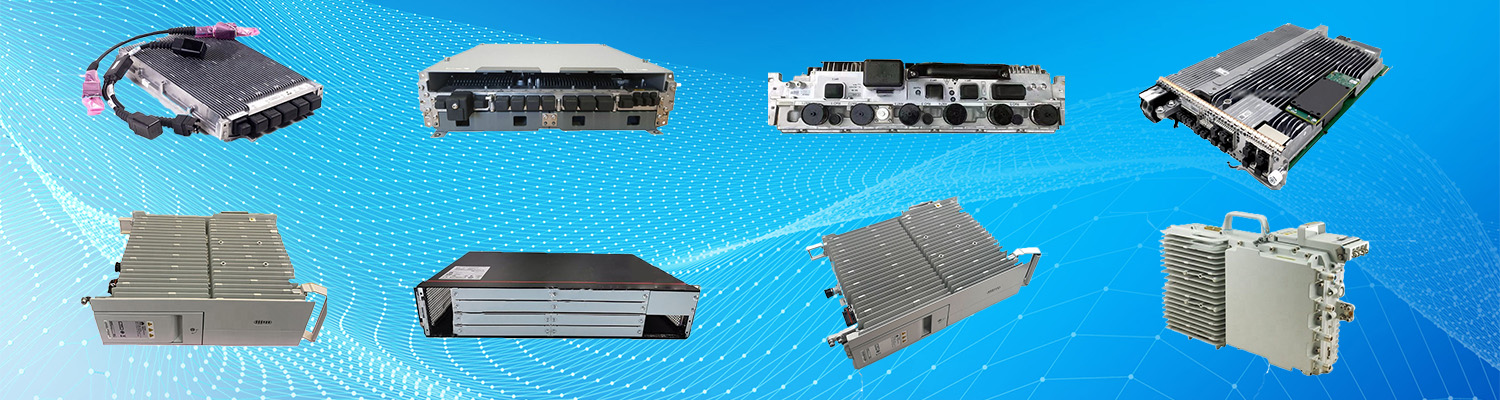
In the era of seamless 5G connectivity, ultra-low latency, and high-capacity wireless communication, Remote Radio Units (RRUs) have become indispensable building blocks of cellular networks. Among all mainstream RRU solutions in the telecom industry, Nokia AirScale RRU stands out for its outstanding reliability, flexible deployment, and cutting-edge technological optimization. As a core component of Nokia’s end-to-end radio access network solutions, it empowers global operators to build efficient, scalable, and future-proof 4G and 5G networks.
What Exactly Is Nokia RRU?
RRU, short for Remote Radio Unit, is a distributed radio frequency device that separates the radio frequency processing module from the traditional integrated base station. Unlike bulky conventional base stations that concentrate all equipment in indoor cabinets, Nokia RRU is designed for outdoor remote deployment, working in tandem with the baseband unit (BBU) via CPRI, eCPRI, or 10GbE Ethernet interfaces .
Nokia’s mainstream RRU series, represented by the AirScale macro RRH (Remote Radio Head) and micro RRU models, covers FDD, TDD, and multi-band working modes. It undertakes core radio frequency functions including signal transmission, reception, amplification, and filtering, serving as the critical bridge between baseband signal processing and antenna signal radiation . This distributed architecture completely solves the signal attenuation problem caused by long coaxial cables in traditional base stations, greatly improving overall network transmission efficiency.
Core Advantages of Nokia AirScale RRU
1. Fast and Flexible Deployment, Cutting Engineering Costs
One of the most iconic strengths of Nokia RRU is its user-friendly deployment design. Equipped with Nokia’s exclusive One-clip rail mount system, the device supports ultra-fast on-site installation. This innovative mounting solution reduces radio installation time by up to 70%, drastically shortening the network “on-air” cycle and accelerating operators’ time-to-market .
Featuring a compact, lightweight modular structure, Nokia RRU adapts to diverse deployment scenarios, including urban tower tops, building facades, suburban base stations, and industrial high-ceiling venues like airports and hangars. Its flexible mounting options and outdoor waterproof and dustproof design eliminate the need for complex indoor equipment rooms, saving massive infrastructure construction and maintenance costs .
2. Powerful Performance for 4G & 5G High-Demand Scenarios
Nokia AirScale RRU integrates advanced telecom technologies such as massive MIMO, beamforming, and carrier aggregation, fully meeting the high bandwidth and low latency requirements of 5G commercial scenarios . High-end models support 4T4R antenna configuration, up to 4×20W RF power output, and a maximum 200MHz RF bandwidth, delivering stable and high-capacity signal transmission .
Whether for dense urban areas with high user traffic, rural wide-area coverage, or private wireless networks for industrial mines, Nokia RRU maintains excellent signal penetration and coverage stability. It effectively solves common network pain points such as dropped calls, slow network speeds, and weak signal coverage, significantly improving end-user communication experience .
3. Intelligent Optimization and High Energy Efficiency
Different from traditional passive radio frequency devices, Nokia RRU embeds AI and machine learning algorithms to realize real-time network self-optimization . It can dynamically adjust signal power, beam direction, and resource allocation according to real-time network traffic and user distribution, automatically adapting to complex and changing network environments without manual intervention.
In addition, equipped with advanced DPD (Digital Pre-Distortion) technology, Nokia RRU achieves ultra-high energy efficiency while ensuring transmission performance . Its low-power operation design effectively reduces operators’ long-term energy consumption and operational costs, conforming to the green and low-carbon development trend of global telecom networks.
4. Strong Compatibility and Future-Proof Scalability
Nokia RRU supports smooth evolution from 4G LTE to 5G NR, enabling operators to complete network upgrading and iteration through software upgrades without large-scale hardware replacement. It is compatible with mainstream network protocols and transmission interfaces including CPRI, eCPRI, and 10GbE, ensuring seamless docking with various Nokia BBU equipment and third-party network devices .
For small-scale indoor coverage and large-scale outdoor macro station scenarios, Nokia’s micro and macro RRU product matrices can be flexibly combined to build customized network solutions, covering full-scenario coverage from urban core areas to remote rural areas .
Typical Application Scenarios of Nokia RRU
Urban Macro Network Coverage: High-power multi-band RRU models are used in urban tower base stations to support high-density user access, solving network congestion in busy business districts, residential areas, and transportation hubs.
Industrial Private Networks: Compact and durable Nokia micro RRUs adapt to harsh industrial environments such as mines, airports, and factory buildings, providing stable wireless connection support for industrial IoT, remote equipment monitoring, and automated production .
Rural and Remote Area Coverage: With high RF power and long-distance transmission capabilities, Nokia RRU expands cell coverage radius, realizing cost-effective wide-area signal coverage in sparsely populated suburban and rural areas .
Indoor High-Quality Coverage: For high-ceiling venues like exhibition halls, stadiums, and warehouses, Nokia RRU delivers excellent signal penetration and uniform coverage, eliminating indoor signal blind spots.
Final Thoughts
As 5G networks continue to deepen commercial deployment and 5.5G and future 6G technologies are gradually iterated, efficient, intelligent, and low-consumption radio access equipment will remain the core of network construction. With its mature industrial design, outstanding performance, intelligent optimization capabilities, and full-scenario adaptability, Nokia AirScale RRU has always been a reliable choice for global operators to build high-quality wireless networks.
It not only simplifies network deployment and reduces operational costs but also lays a solid hardware foundation for the intelligent evolution of future wireless networks, continuously empowering digital transformation in industries such as communication, manufacturing, and transportation.